Quick Summary
Animal Feed Quality Parameters play a critical role in determining the nutritional value, safety, and performance of livestock feed. Animal Feed Quality Parameters play a critical role in determining the nutritional value, safety, and performance of livestock feed. Whether you manage a poultry farm, dairy operation, feed mill, or feed ingredient business, understanding these quality indicators can help improve animal health, feed efficiency, and profitability. Moreover, high-quality feed supports better growth rates, milk production, and feed conversion efficiency. As a result, producers can achieve stronger financial returns and more consistent animal performance. Therefore, evaluating feed quality should be a priority before purchasing any feed ingredient or finished feed product.
What Are Animal feed quality parameters?
feed quality parameters are measurable characteristics that determine the nutritional value, safety, consistency, and performance of feed ingredients or finished feed. They help buyers assess whether a feed product can meet animal nutritional requirements and support optimal production.
Simply put, feed quality parameters tell you whether the feed is safe, nutritious, and worth your investment.
Why Animal Feed Quality Parameters Matter
Feed typically represents 60–70% of total livestock production costs. Poor-quality feed can lead to slow growth, reduced milk yield, poor feed conversion ratios (FCR), health issues, and lower profitability.
High-quality feed offers several advantages:
- Better growth and weight gain
- Improved milk and egg production
- Stronger immunity
- Higher feed efficiency
- Reduced veterinary costs
- Greater farm profitability
Ultimately, farms that prioritize feed quality often achieve better productivity, healthier animals, and stronger financial returns.
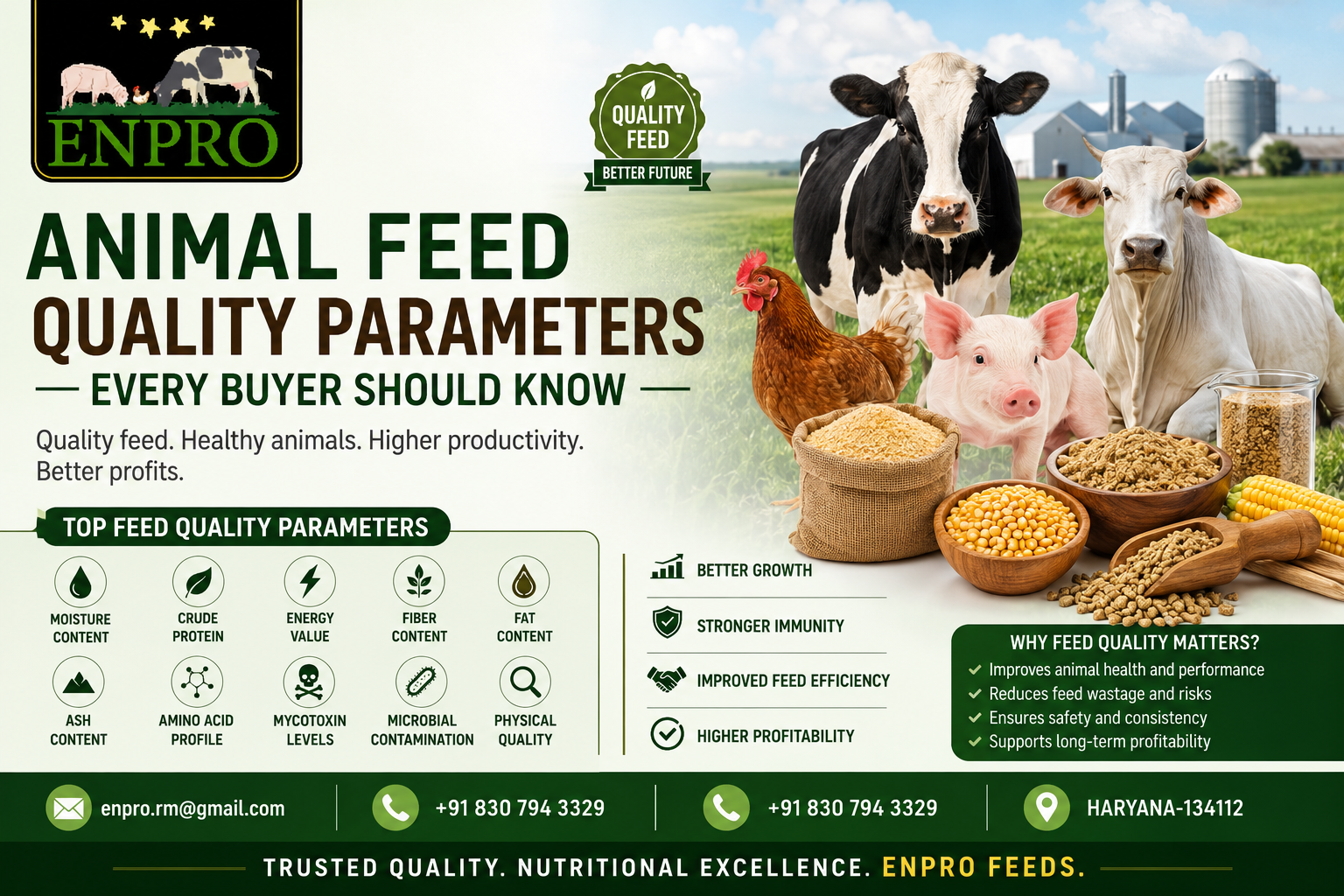
Top 10 Animal Feed Quality Parameters Every Buyer Should Evaluate
1. Moisture Content
First and foremost, moisture content significantly affects feed shelf life, storage stability, and overall ingredient quality.
Ideal Range: Below 12%
High moisture levels can cause:
- Mold growth
- Mycotoxin contamination
- Nutrient losses
- Reduced shelf life
Always ensure feed is stored in dry, well-ventilated conditions.
2. Crude Protein Content
As one of the most important animal feed quality parameters, crude protein directly influences muscle development, milk production, egg formation, and overall animal performance.
Typical Protein Levels:
| Ingredient | Crude Protein (%) |
|---|---|
| Rice DDGS | 38–45 |
| Corn DDGS | 26–32 |
| Mustard DOC | 34–38 |
| Soybean Meal | 44–48 |
| Maize Gluten Meal | 58–62 |
Because crude protein is one of the most important animal feed quality parameters, higher protein quality often results in better productivity, improved feed efficiency, and stronger production outcomes.
3. Energy Value
Energy fuels all biological functions including growth, maintenance, reproduction, and production.
Additionally, common ingredients like corn, DDGS, cereal grains, and vegetable oils serve as major energy sources in feed formulations.
Because energy is a critical animal feed quality parameter, low-energy feed often leads to reduced growth, poor feed efficiency, and lower overall performance, even when protein levels appear adequate.
4. Fiber Content
Fiber plays an important role in digestive health, particularly in ruminants.
Benefits include:
- Improved gut health
- Better digestion
- Enhanced rumen function
Excessive fiber, however, may reduce nutrient digestibility and energy utilization.
5. Fat Content
Fat is the most concentrated source of dietary energy.
Benefits include:
- Higher energy density
- Better feed palatability
- Improved nutrient absorption
- Enhanced growth performance
Buyers should also check for signs of rancidity or fat oxidation.
6. Ash Content
Ash represents the total mineral content in feed.
Excessively high ash levels may indicate:
- Contamination
- Adulteration
- Poor ingredient quality
Balanced mineral content is essential for bone development, metabolism, and production performance.
7. Amino Acid Profile
Protein quantity alone does not determine feed quality. The amino acid profile is equally important.
Key amino acids include:
- Lysine
- Methionine
- Threonine
Proper amino acid balance improves:
- Growth rates
- Feed conversion efficiency
- Protein utilization
- Production performance
8. Mycotoxin Levels
Mycotoxins are toxic compounds produced by molds growing on feed ingredients.
Common mycotoxins include:
- Aflatoxins
- Ochratoxins
- Fumonisins
- DON (Vomitoxin)
High mycotoxin levels can cause:
- Reduced feed intake
- Poor growth
- Reproductive problems
- Immune suppression
Regular screening is essential.
9. Microbial Contamination
Feed contamination by harmful microorganisms can create serious health risks.
Important pathogens include:
- Salmonella
- E. coli
- Clostridium species
Microbial contamination may affect animal performance and food safety throughout the supply chain.
10. Physical Animal feed quality parameters
A simple visual inspection can reveal valuable information.
Check for:
- Consistent color
- Fresh smell
- Uniform texture
- Absence of mold
- No foreign materials
Feed that appears abnormal should always be tested before use.
Feed Quality Testing Methods for Animal Feed Quality Parameters
Modern feed quality assurance relies on several testing techniques:
Laboratory Analysis
Provides accurate measurement of protein, fiber, fat, ash, minerals, and moisture.
NIR (Near-Infrared Reflectance) Analysis
Offers rapid nutrient analysis with minimal sample preparation.
Moisture Testing
Helps prevent storage losses and spoilage.
Protein Analysis
Determines crude protein levels and ingredient consistency.
Mycotoxin Screening
Identifies harmful mold toxins before feed reaches animals.
Routine testing reduces risk and ensures consistent feed quality.
Feed Quality Standards and Certifications
Reliable suppliers typically follow recognized quality standards such as:
- BIS (Bureau of Indian Standards)
- GMP (Good Manufacturing Practices)
- HACCP (Hazard Analysis and Critical Control Points)
- ISO Quality Management Systems
- Feed Safety and Quality Assurance Programs
These standards help ensure product consistency, safety, and traceability.
Animal Feed Quality Parameters Comparison Table
| Parameter | Ideal Condition | Importance | Risk if Poor |
|---|---|---|---|
| Moisture | <12% | Storage stability | Mold growth |
| Protein | Ingredient specific | Growth and production | Reduced performance |
| Energy | Balanced formulation | Feed efficiency | Poor productivity |
| Fiber | Species dependent | Digestive health | Lower digestibility |
| Fat | Fresh and stable | Energy density | Reduced intake |
| Ash | Within specification | Mineral supply | Adulteration concerns |
| Amino Acids | Balanced profile | Protein utilization | Poor FCR |
| Mycotoxins | Minimal levels | Animal health | Toxicity |
| Microbial Load | Within safe limits | Feed safety | Disease risk |
| Physical Quality | Uniform appearance | Consistency | Reduced acceptance |
Common Mistakes Buyers Make
Many buyers focus only on price while ignoring quality.
Common mistakes include:
- Purchasing solely on cost.
- Ignoring laboratory test reports.
- Not checking moisture levels.
- Overlooking mycotoxin risks.
- Ignoring supplier reputation.
- Failing to inspect feed physically.
- Not verifying nutrient consistency.
- Poor storage practices.
- Not reviewing certifications.
- Using untested ingredients.
Feed Inspection Checklist Before Purchase
Use this checklist before placing an order:
✅ Moisture within acceptable range
✅ Protein specification verified
✅ No visible mold
✅ Fresh smell
✅ Uniform appearance
✅ Supplier quality certifications available
✅ Laboratory analysis report provided
✅ Mycotoxin testing completed
✅ Proper packaging
✅ Traceability documentation available
Case Study: How Feed Quality Improved Farm Profitability
A commercial poultry farm experienced inconsistent growth performance and poor feed conversion ratios.
After switching to regularly tested, high-quality feed ingredients:
- Average body weight increased by 8%
- Feed conversion ratio improved by 5%
- Mortality decreased by 3%
- Overall profitability improved significantly
The primary improvements came from better protein consistency, lower moisture content, and improved mycotoxin control.
This example highlights how feed quality directly influences financial performance.
Expert Insights
From an animal nutrition perspective, the best feed is not necessarily the cheapest. Buyers should focus on nutrient consistency, digestibility, safety, and supplier reliability.
Regular testing, proper storage, and purchasing from trusted suppliers can significantly improve livestock performance and reduce production risks.
Feed Quality Trends in 2026
The feed industry is rapidly adopting new technologies, including:
- Digital feed testing systems
- AI-based nutrient analysis
- Real-time traceability platforms
- Sustainable feed ingredient sourcing
- Advanced mycotoxin monitoring
These innovations are helping producers improve quality control and make more informed purchasing decisions.
FAQs About Animal Feed Quality Parameters
What is feed quality?
Feed quality refers to the nutritional value, safety, consistency, and performance potential of feed ingredients or finished feed.
Why is moisture important in feed?
High moisture promotes mold growth, nutrient losses, and spoilage.
How is feed quality tested?
Through laboratory analysis, NIR testing, moisture testing, protein analysis, and mycotoxin screening.
What is crude protein in animal feed?
Crude protein measures the total protein content available for animal growth and production.
How can buyers identify quality feed?
By reviewing test reports, checking certifications, conducting visual inspections, and sourcing from reputable suppliers.
What are Animal Feed Quality Parameters?
Animal Feed Quality Parameters are measurable indicators such as moisture, protein, energy, fiber, fat, amino acids, mycotoxins, and microbial contamination that determine the nutritional quality, safety, and effectiveness of feed ingredients and finished feed.
Conclusion
Understanding and evaluating Animal Feed Quality Parameters is essential for making informed feed purchasing decisions and achieving consistent livestock performance. By evaluating moisture, protein, energy, fiber, fat, amino acids, mycotoxins, microbial contamination, and physical quality, buyers can make informed purchasing decisions and reduce production risks.
Rather than focusing solely on price, successful farmers and feed manufacturers prioritize consistent quality, safety, and nutritional value. A proactive approach to feed quality management leads to healthier animals, better productivity, and stronger long-term returns.
Partner with Enpro Feeds for Quality Feed Ingredients
At Enpro Feeds, we are committed to supplying high-quality feed ingredients that meet the nutritional and quality requirements of modern livestock and poultry operations.
Our product range includes:
- Rice DDGS
- Corn DDGS
- Maize Gluten
- Mustard DOC
- Other premium animal feed raw materials
Contact Enpro Feeds today to learn how our quality-focused feed solutions can support your livestock performance and business growth.