
Introduction
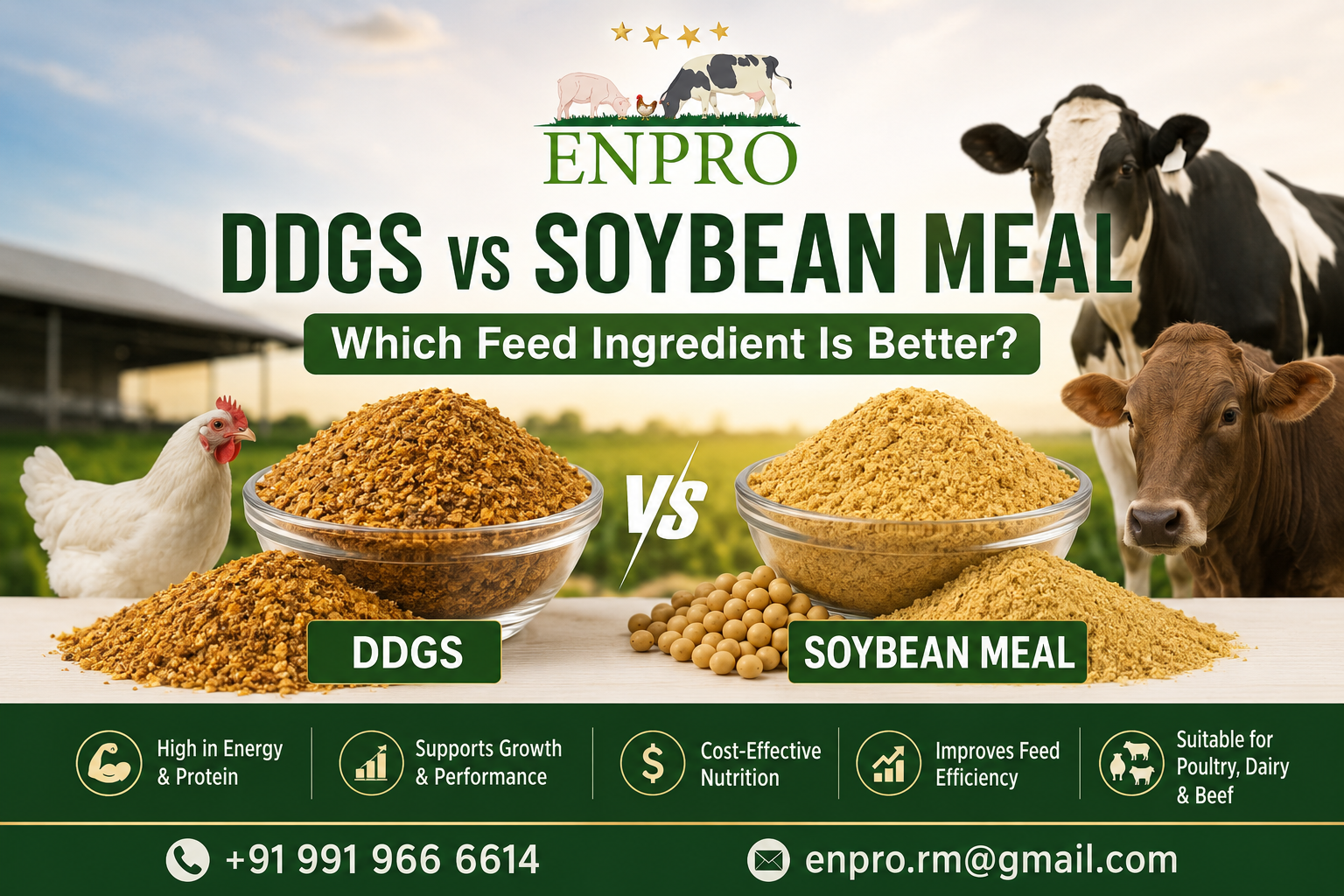
Feed ingredients play a critical role in animal nutrition, affecting growth performance, milk production, feed efficiency, and overall profitability. Among the many protein and energy sources available today, Distillers Dried Grains with Solubles (DDGS) and Soybean Meal are two of the most widely used options in livestock and poultry diets.
While soybean meal has long been considered the standard protein source, DDGS has gained popularity due to its nutritional value and cost-effectiveness. However, choosing between the two is not always straightforward. The right option depends on your production goals, animal type, feed costs, and nutritional requirements.
In this article, we’ll compare DDGS and soybean meal in terms of nutrition, cost, and benefits for poultry, dairy cattle, and beef cattle to help you make an informed decision.
What is DDGS?
Distillers Dried Grains with Solubles (DDGS) are a co-product of the ethanol production process. When grains such as corn are fermented to produce ethanol, the starch is removed, leaving behind concentrated nutrients including protein, fiber, fat, vitamins, and minerals.
Because most of the starch is extracted during ethanol production, the remaining nutrients become more concentrated, making DDGS a valuable feed ingredient for livestock.
Key Characteristics of DDGS
- Rich source of energy and protein
- Contains higher fiber than soybean meal
- Provides essential amino acids
- Good source of phosphorus and other minerals
- Commonly used in poultry, dairy, beef, and swine diets
What is Soybean Meal?
Soybean meal is produced after oil is extracted from soybeans. It is one of the most widely used protein sources in animal feed due to its high protein content and excellent amino acid profile.
For decades, soybean meal has been the benchmark ingredient for balancing protein requirements in livestock and poultry diets.
Key Characteristics of Soybean Meal
- High-quality protein source
- Excellent digestibility
- Rich in essential amino acids, especially lysine
- Consistent nutrient profile
- Widely available across global feed markets
Nutritional Comparison
Although both ingredients provide valuable nutrients, they differ significantly in composition.
| Nutrient | DDGS | Soybean Meal |
|---|---|---|
| Crude Protein | 26–32% | 44–48% |
| Energy Content | Higher | Moderate |
| Crude Fiber | Higher | Lower |
| Fat Content | Higher | Lower |
| Lysine | Lower | Higher |
| Phosphorus | Higher | Moderate |
| Digestibility | Good | Excellent |
What Does This Mean?
Soybean meal is generally superior when the goal is maximizing protein quality and amino acid balance. DDGS, on the other hand, provides a combination of protein and energy, making it an attractive option for reducing feed costs while maintaining performance.
Many nutritionists use both ingredients together to achieve the best balance between nutrition and economics.
Cost Comparison
Feed costs often represent the largest expense in livestock production. As a result, ingredient pricing can significantly influence profitability.
In many markets, DDGS is typically less expensive than soybean meal on a per-ton basis. This makes it an appealing alternative when soybean prices rise or protein costs become a concern.
DDGS Advantages in Terms of Cost
- Lower cost per unit of energy
- Helps reduce overall feed expenses
- Provides both protein and energy in a single ingredient
- Can partially replace more expensive protein sources
Soybean Meal Advantages in Terms of Cost
- Higher protein concentration means lower inclusion rates may be required
- More predictable nutrient profile
- Easier ration formulation
The most economical choice often depends on local ingredient availability and market prices.
Poultry Benefits
Benefits of DDGS for Poultry
DDGS can be successfully included in poultry diets when used at appropriate levels.
Advantages include:
- Additional energy from residual fat
- Source of phosphorus and trace minerals
- Potential reduction in feed costs
- Supports growth performance when balanced properly
However, excessive inclusion may affect amino acid balance and nutrient digestibility.
Benefits of Soybean Meal for Poultry
Soybean meal remains the preferred protein source in poultry nutrition because of its highly digestible amino acids.
Advantages include:
- High lysine content
- Excellent protein quality
- Supports rapid growth and feed conversion
- Suitable for broilers and laying hens
For poultry producers focused on maximum performance, soybean meal often serves as the foundation of the feed program.
Dairy Cattle Benefits
Benefits of DDGS for Dairy Cattle
DDGS has become a popular ingredient in dairy rations due to its combination of protein, digestible fiber, and energy.
Benefits include:
- Supports milk production
- Provides rumen-friendly fiber
- Supplies highly available phosphorus
- Can improve feed efficiency
- Often lowers ration costs
Benefits of Soybean Meal for Dairy Cattle
Soybean meal provides a highly digestible protein source that supports milk yield and reproductive performance.
Benefits include:
- High-quality protein
- Reliable nutrient consistency
- Effective source of rumen degradable protein
- Supports microbial protein synthesis
Many dairy nutritionists use a combination of DDGS and soybean meal to optimize both performance and cost.
Beef Cattle Benefits
Benefits of DDGS for Beef Cattle
DDGS is particularly valuable in beef production because cattle can efficiently utilize its fiber and energy content.
Advantages include:
- Promotes weight gain
- Excellent energy source
- Supports feedlot performance
- Reduces feed costs
- Works well in backgrounding and finishing diets
Benefits of Soybean Meal for Beef Cattle
Soybean meal is commonly used when additional protein is required, especially in young or growing cattle.
Advantages include:
- Supports muscle development
- High protein concentration
- Improves ration balance
- Useful in forage-based feeding systems
For many beef operations, DDGS offers a more cost-effective solution, while soybean meal is used strategically to meet protein requirements.
Which One Should You Choose?
There is no single answer because the best choice depends on your feeding objectives.
Choose DDGS if:
- You want to reduce feed costs
- Additional energy is needed in the ration
- You are feeding dairy or beef cattle
- Local DDGS prices are favorable
Choose Soybean Meal if:
- Maximum protein quality is the priority
- You need higher lysine levels
- You are formulating diets for young animals or poultry
- Consistent nutrient composition is essential
In many cases, the most effective feeding strategy is not choosing one over the other but combining both ingredients. This approach can provide the protein quality of soybean meal along with the energy and economic benefits of DDGS.
FAQs
Is DDGS a replacement for soybean meal?
DDGS can partially replace soybean meal in many livestock diets, but complete replacement is not always recommended because DDGS contains lower levels of certain essential amino acids.
Which ingredient contains more protein?
Soybean meal generally contains significantly more crude protein than DDGS.
Is DDGS good for dairy cows?
Yes. DDGS provides protein, digestible fiber, and energy, making it a valuable ingredient in dairy cattle diets.
Can poultry eat DDGS?
Yes. Poultry can utilize DDGS effectively when it is included at appropriate levels and balanced with other ingredients.
Which is more cost-effective?
DDGS is often more economical because it supplies both energy and protein at a lower cost than soybean meal. However, actual cost-effectiveness depends on local market prices and ration requirements.
Conclusion
Both DDGS and soybean meal offer significant nutritional value and can contribute to profitable livestock production. Soybean meal remains the gold standard for protein quality, while DDGS provides a cost-effective combination of energy, protein, and minerals.
If you’re looking for reliable DDGS suppliers in India, Enpro Feeds offers quality feed ingredients backed by industry expertise and consistent supply.
Rather than viewing them as competitors, many successful producers use them together to create balanced, economical diets that support animal health and performance. Evaluating your nutritional goals, feed prices, and production system will help determine the ideal mix for your operation.